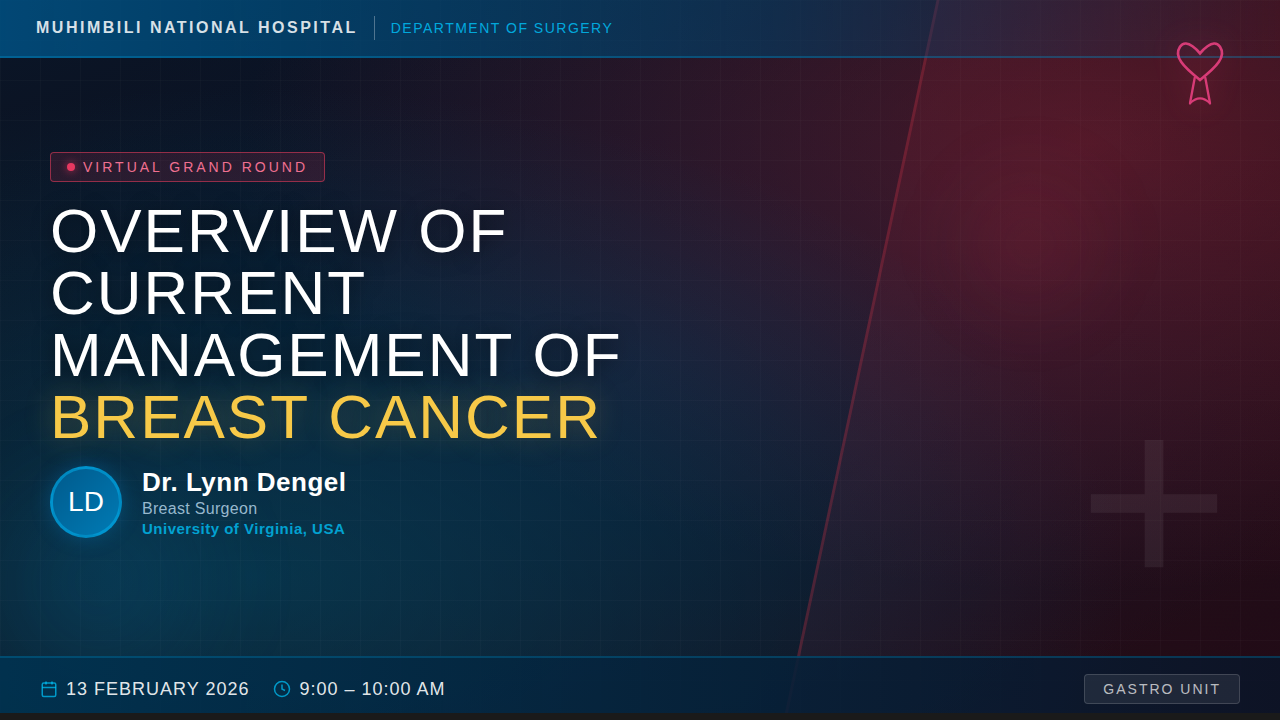
On February 13, 2026, the Department of Surgery, Muhimbili National Hospital hosted a grand round presentation on Key Topics in Breast Surgery and Breast Cancer Care, featuring Dr. Lynn T. Dengel, a breast surgeon from the University of Virginia (UVA) Cancer Center. The session provided a comprehensive overview of modern breast cancer management, from diagnosis through surgical treatment and the evolving trend of treatment de-escalation.
Dr. Dengel opened the session by highlighting the multidisciplinary approach practiced at the UVA Breast Care Center, where a dedicated tumor board convenes weekly to discuss complex cases. This model brings together breast surgeons, medical oncologists, radiation oncologists, radiologists, pathologists, genetic counselors, and plastic surgeons — ensuring that each patient receives individualized, evidence-based care. She emphasized that this team-based approach is the gold standard for breast cancer management worldwide.
✦ Key Areas Covered
The presentation covered the spectrum of breast cancer diagnosis, beginning with ductal carcinoma in situ (DCIS) — a non-invasive condition where abnormal cells are confined to the milk ducts — through to invasive cancers that have penetrated beyond the ductal or lobular basement membrane. Dr. Dengel explained the BI-RADS (Breast Imaging Reporting and Data System) classification used to standardize mammographic findings, where categories range from 0 (incomplete) to 6 (known malignancy). For suspicious lesions (BI-RADS 4–5), she emphasized the role of core needle biopsy as the diagnostic gold standard, noting its approximately 1% false-negative rate — a figure that underscores the importance of clinical-radiological-pathological correlation.
Dr. Lynn T. Dengel
Breast Surgeon
University of Virginia Cancer Center
A significant portion of the grand round was dedicated to surgical approaches in breast cancer. Dr. Dengel reviewed the different types of mastectomy — from simple (total) mastectomy to skin-sparing and nipple-sparing mastectomy, which has gained prominence for its superior cosmetic outcomes when combined with immediate reconstruction. She noted that inframammary fold (IMF) incisions are preferred for nipple-sparing procedures due to better visualization and cosmesis. Additionally, she discussed breast conserving therapy (lumpectomy with radiation), which has been shown to offer equivalent survival to mastectomy for appropriately selected patients. The current standard for surgical margins in breast conserving surgery is "no tumor on ink" — meaning no cancer cells at the inked surgical edge — a guideline established by the SSO-ASTRO consensus.
The session also explored sentinel lymph node biopsy (SLNB), which has replaced routine axillary lymph node dissection for clinically node-negative patients. Dr. Dengel described the dual-tracer technique using technetium-99m (Tc-99m) radiotracer and methylene blue dye, which together achieve a sentinel node identification rate of 90–95%. She emphasized the importance of the learning curve, citing literature suggesting that surgeons should perform approximately 30 procedures with concurrent axillary dissection validation before independently performing SLNB. This point resonated particularly with the MNH surgical trainees in attendance.
"The trend in breast cancer surgery is toward doing less, not more — de-escalation of treatment means we can offer patients equivalent oncologic outcomes with less morbidity and better quality of life."
Dr. Dengel dedicated the final section of her talk to the de-escalation of breast cancer treatment, a paradigm shift supported by several landmark clinical trials. She reviewed the CALGB 9343 trial, which demonstrated that women aged 70 and older with small, hormone receptor-positive tumors may safely omit radiation after lumpectomy without compromising survival. The PRIME II trial reinforced these findings in a similar population. She discussed the groundbreaking SOUND Trial (JAMA 2023), which showed that sentinel lymph node biopsy itself may be omitted in select patients with small, clinically node-negative tumors without compromising outcomes. Finally, the ACOSOG Z0011 and AMAROS trials were reviewed, both supporting the omission of complete axillary dissection in patients with limited sentinel node metastases — representing a major shift away from the previously standard aggressive axillary surgery.
This grand round exemplified the growing collaboration between MNH, MUHAS, and international surgical centers in advancing surgical education in East Africa. The interactive Q&A session that followed Dr. Dengel's presentation demonstrated the high level of engagement from surgical residents and faculty. Watch the full recording above to benefit from this outstanding educational session.